The Importance of Stretching for Fibromyalgia
I didn’t understand the importance of stretching for fibromyalgia in the beginning. Like most patients newly diagnosed with fibromyalgia my doctor had told me I needed to exercise. He’d also prescribed physical therapy. However, also like most patients newly described with fibromyalgia I had no idea why (nor did the doctor attempt to tell me).
When I was first diagnosed with Fibro and sent for Physical Therapy they gave me a list of stretches for Fibromyalgia to do daily. After a couple of weeks of being honest with my PT, and saying that no I really wasn’t doing my stretching for fibromyalgia regularly, she told me that perhaps she needed to show me the stretches again because maybe I wasn’t doing them right. Something must be wrong, she said, or you’d WANT to do them. I kinda blew off her statement at the time. But looking back, I know she was right.
I’d love to say I stretch every day now but it wouldn’t be true. However, when I do wake up feeling tighter or a little more “Fibro-ey”, I stretch.
I stretch throughout the day when muscles feel tight, and sometimes I wake up in the night and I stretch.
Stretching is the one thing that I know will make specific areas feel better despite fibromyalgia. Most of my stretching I do in the bed before I ever consider getting up in the morning. Some days (as we all know) I’m tighter than others. Those days I stretch more, because I have to – just to get out of bed. Other days I wake up with good movement and I don’t really bother.
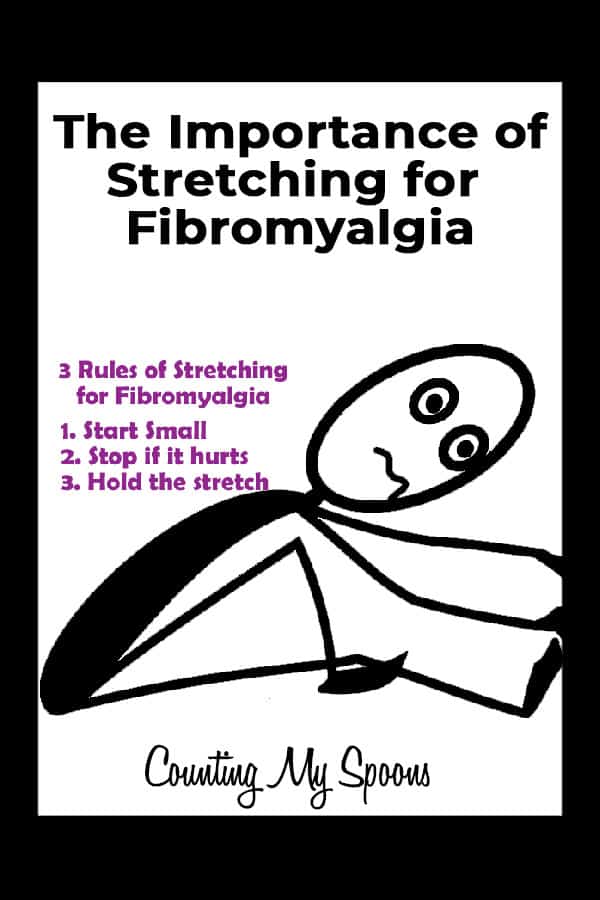
3 Rules of Stretching for Fibromyalgia
Before you attempt to get started with stretching for fibromyalgia, here are a few rules that finally made the difference for me and turned stretching for fibromyalgia into something helpful instead of “exercise” or even “painful”.
1. Start Small. You don’t have to do the full movement the first time (or even the first 10 times). You may not be able to reach your toes (or complete a stretch) and that’s ok. Just do what you can to start and eventually you will find what works, and find you want to repeat the stretches regularly.
2. Don’t stretch any further than is comfortable. You should feel a slight stretch but if you feel strain (or pain) you’ve gone too far. Back off or stop completely. Understanding what your body is saying to you is essential in proper stretching for fibromyalgia. Too often we are taught that a little pain is a good thing. It’s not. If it hurts, STOP.
3. Hold the Stretch. Ideally you want to hold most stretches for 2 minutes, but early on you won’t be able to (you may never get to 2 minutes). Hold it as long as you can without feeling pain or strain
The Difference Between a Stretch and Straining – I never realized there was one until my last attempt through physical therapy. It seemed that other PT’s I’d gone to told me to hold it till it hurt, or that “a little pain is a good thing”. It’s not a good thing. Stretching should feel good. Strain is when your muscle is working too hard and you will feel it both during the stretch and later. It may take a bit to really listen to your body and understand the difference, but if your body is saying “this is too much” listen to it. Pain is not a good thing. We are stretching to avoid pain throughout the day, not to increase pain.
Stretches for Fibromyalgia
I was going to group these stretches by what they stretch but instead I’m going to give them to you in the order that I do them (typically from easiest to hardest – sometimes I don’t make it to the harder ones). Where I could I included images to show you these stretches.
– Full Body Stretch – Laying flat on my back in bed I attempt to lengthen everything. I start by extending my legs straight out as far as they can go and pointing my toes out, then bringing them back to a straight position and pulling my toes towards my head. I then extend my arms out to my side stretching them as far as they will go, then slowly move them up above my head and hold them. You should feel a few small adjustments (or pops) as you do this and work out some of the “kinks” from the night before. If you think about it these are the same stretches your body does naturally when you yawn and stretch. You are just doing them on purpose.
– Pelvic Tilt – laying flat on your back, bend your knees, keeping your feet flat on the ground. Press the small of your back into the bed while slightly lifting the bottom of your pelvis up. The pelvic movement is so slight that if someone is in bed with you they won’t even realize you are doing it, but you will feel it. I take this a step further (once I feel I can) into the…
– Pelvic Tilt into Table/Bridge – from the same position, lift your pelvis off of the bed, supporting your body on your shoulders and feet. Your body should be a straight line from your shoulders to your knees Hold this for 10 seconds (increase duration as you increase ability). Release back to the bed and then repeat.
– Hip Flex/ Back Stretch – lying on your back, stretch one leg out straight, while pulling the other knee into your chest and hold. Then alternate. After you’ve done each leg separately pull both knees in to your chest and roll your chest toward your knees at the same time so that your back is curled and your head is looking at your knees.
–Lower Back Rotation Stretch – Lying on your back with your arms spread apart and knees up, allow your knees to fall to the side. Keep upper back/shoulders and arms flat against the bed.
– Hamstring Stretch (seated) – this stretch is quite often my benchmark for the day. If I can touch my toes it’s a good thing. If I can’t touch my toes I’m really tight that day and I’m probably not going to come out of that tightness for a while. These are the days when more stretching is usually required to get me out of bed (sometimes interspersed with naps).
– Single Leg Hamstring Stretch – Keeping one leg straight out with toes flexed upward, bend the other leg placing your foot flat against the inside of the straight leg. Lean forward reaching your hands towards your toes. Don’t hurt yourself by stretching too far. If you can’t reach your toes, then grab your leg as far down as you can reach and hold. As you do this stretch more you’ll eventually reach your toes (I did).
– Piriformus Muscle – This stretch can be done laying on your back or sitting in a chair.
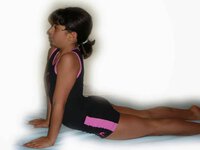 |
| Cobra pose |
– Back Extension (Cobra) – lying on your stomach, put your arms forward with your hands slightly outstretched from your head. Push your shoulders upward. You really should just be bending from the back, if you don’t have much strength in your arms and shoulders, don’t try to go very far up. Let your back do the work.
– Cat/ Cow Stretch – Get on all fours with your head down and your back curved up. Butt in (almost like you are trying to look at your pelvis. Hold that for a breath, then as you breath out, lift your head up while pushing your butt out and allowing your back to bow inward toward the bed. Continue this movement through several breaths.
Unfortunately, you do eventually have to get out of bed, and once you do, there are a few more stretches you should do for other areas of your body. I like to do these in the shower, as the warm water helps to loosen things up.
– Neck and Shoulder Stretch – if you are like me and have neck/shoulder issues holding this stretch may be difficult and even painful. A good alternative is to put your arm behind your back as shown in the image but then place that hand against a wall, rather than using the opposite hand to hold it back there.
– Upper Back Stretch – Just put your hands against the shower wall as shown and stretch out while the water warms your muscles.
– Chest Stretch – This is basically the opposite of the neck/shoulder stretch above. Again I do it on the wall in the shower. Facing the wall, place one arm flat on the wall straight out at shoulder height. Then slowly turn your body away from the wall, keeping your arm against the wall. Hold for 30 seconds then repeat with the other side.
– Shoulder Stretch – Facing the wall, place your hands palms out on the wall and slide them up as far as they will go above your head. Ideally, you want to be as close to the wall as possible before you start and get your hands all the way above your head bringing your nose touching the wall.
Of course, there are plenty more stretches you can do and if you have a chiropractor or physical therapists you may want to ask them to give you some diagrams of specific stretches that would help you with your specific areas of pain. You can also just go to Google and type in “stretching” with the body part you have trouble with and you will find some great resources for stretching different areas of your body.
So how bout it? Do you stretch regularly? If so do you have a typical routine you do or certain stretches that you find more helpful for fibromyalgia than others?




Ashley says
In the middle of a huge flare up and stretched just in hopes it would do anything… I can’t believe how much just concentrating on one of these helped the rest of my muscles to finally relax. This list of more stretches to regularly try is just what I was looking for. Thank you!
ME/CFS Self-help Guru says
Wow this almost matches my daily yoga routine exactly. Only a few slightly different postures stretching similar areas! I tend to go into and out of the positions about 3 times matching the movement to my breathing and holding for a short time on the final position. I often find that the letting go after the stretch is the most beneficial moment and often spend more time relaxing between stretches!
Julie says
Exactly! Once you get the basics of how to do each move, it’s so easy to let them flow (and so much better for us).
Jill (@Spoonie_Girl) says
Pinned the stretching info to my account…good stuff !
JulieRyan says
Thanks. Definitely important stuff. I can tell when I’m not doing it.
Chest Stretch says
Wow so nice! I like this site.Keep it working every day.